

The kernel is one of the most fundamental components of an operating system (OS). It serves as a bridge between the hardware and the software, ensuring that various applications can function smoothly on a device. This blog post will delve into the intricacies of the kernel, its functions, types, and its vital role in computer systems. We will also explore different architectures, the process of development, and its future prospects.
What is a Kernel?
At its core, it is the central part of an operating system. It has complete control over everything in the system. It’s primary function is to manage the system’s resources and allow other programs to run and use these resources. This includes managing the CPU, memory, and input/output (I/O) devices.

Functions of the Kernel
- Process Management: It is responsible for creating, scheduling, and terminating processes. It ensures that each process gets the necessary CPU time and manages context switching between processes.
- Memory Management: It manages the system’s memory, ensuring that each process has enough memory to execute while also preventing processes from accessing each other’s memory.
- Device Management: It acts as an intermediary between the hardware and the software. It manages device communication, interprets signals from hardware, and ensures that devices are allocated efficiently to different processes.
- System Calls and Security: It provides a set of system calls that applications can use to request services from the OS. It also enforces security by managing permissions and access control.
- File System Management: It manages the file system, keeping track of files and directories on storage devices, and handling file operations such as read, write, and delete.
Types of Kernels
There are several types of kernels, each with its own architecture and way of handling system operations.
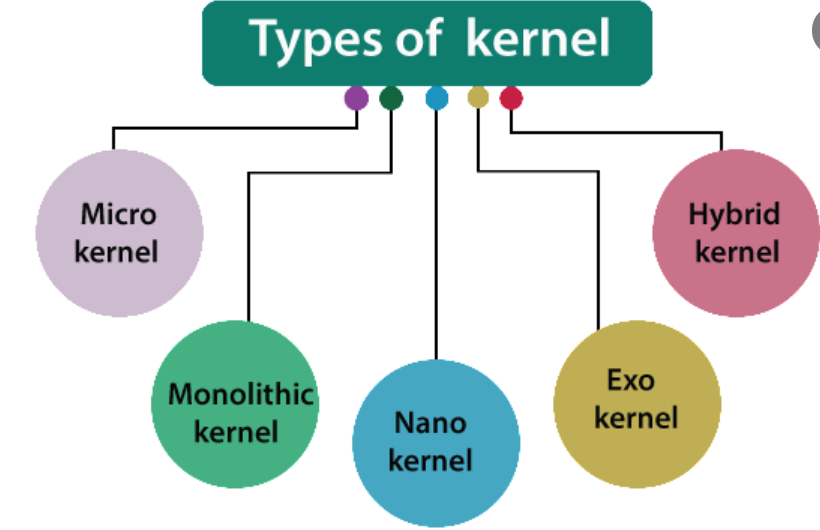
- Monolithic Kernels:
- Description: It all OS services run in the same memory space. This includes device drivers, file system management, and system server calls.
- Advantages: High performance due to minimal context switching and system call overhead.
- Disadvantages: Large size and complexity, making it harder to maintain and secure.
- Microkernels:
- Description: It run the most basic functions like process and memory management in the kernel space, while other services run in user space.
- Advantages: Improved security and stability since a failure in user space services does not crash the entire system.
- Disadvantages: Potentially lower performance due to more context switching and communication between user space and kernel space.
- Hybrid Kernels:
- Description: It combine elements of monolithic and microkernels. They run some services in kernel space for performance reasons but keep others in user space.
- Examples: Modern Windows operating systems use a hybrid kernel.
- Exokernels:
- Description: It strive to provide minimal abstractions, allowing applications to have more direct control over hardware.
- Advantages: Highly efficient and flexible.
- Disadvantages: Complex to program and manage due to low-level hardware interactions.
- Nanokernels:
- Description: An even smaller subset of microkernels that focus on hardware abstraction and minimalism.
- Advantages: Extremely lightweight and fast.
- Disadvantages: Very limited in functionality, often requiring additional components to be useful.
Kernel Architecture
It defines how it manages system operations and resources. Below are some common architectural designs:
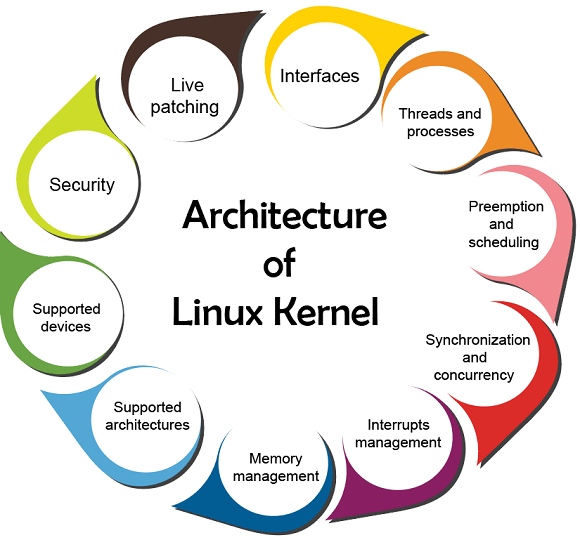
Layered Architecture
In this architecture, It is divided into a series of layers, each built on top of the other. The lowest layer interacts directly with the hardware, while the highest layer interacts with the user applications. Each layer only interacts with the layer directly below or above it, ensuring modularity and ease of debugging.
Client-Server Model
This model is often used in microkernels where various services are implemented as separate server processes. It acts as a client, making requests to these servers for various operations. This separation enhances security and stability.
Monolithic Architecture
As previously mentioned, in a monolithic architecture, all its services run in a single address space. This design is typical in many Unix-like operating systems such as Linux. It offers performance benefits but can be less secure and harder to maintain.
Kernel Development
It is a complex task requiring a deep understanding of both hardware and software. Below are some key aspects of kernel development:
Development Environment
It typically requires a cross-compilation environment because developing directly on the target hardware can be impractical. Developers often use virtual machines or separate hardware to test their kernels.
Bootloaders
A bootloader is a program that loads the kernel into memory and starts its execution. Examples of popular bootloaders include GRUB (GNU GRand Unified Bootloader) for Linux systems and the Windows Boot Manager.
Kernel Modules
It support the use of modules, which are pieces of code that can be loaded and unloaded from the kernel at runtime. This modularity allows for easier updates and the addition of new features without restarting the system.
Debugging and Testing
It is challenging due to its low-level operations and the lack of debugging tools that can operate at this level. Techniques such as kernel logging, using serial ports for output, and employing specialized debugging tools like GDB (GNU Debugger) are often used.
The Role in Modern Computing

The kernel’s role has evolved with advancements in hardware and software. In modern computing, It is designed to handle a variety of tasks beyond the basic functions mentioned earlier. These include:
Virtualization
It now support virtualization technologies, allowing multiple operating systems to run on a single physical machine. This is critical for cloud computing and data centers.
Power Management
With the rise of mobile and embedded devices, power management has become a crucial function of the kernel. It ensures efficient use of battery and energy resources.
Real-Time Operations
Real-time kernels are designed to handle tasks that require precise timing and high reliability, which are essential in industries like automotive, telecommunications, and aerospace.
Security Enhancements
Modern kernels incorporate advanced security features such as SELinux (Security-Enhanced Linux), which provides mechanisms for enforcing mandatory access control policies.
Future of Development
As technology continues to advance, It faces new challenges and opportunities. Some of the future trends in kernel development include:
Quantum Computing
As quantum computing becomes more practical, it will need to be developed to manage quantum hardware and integrate quantum and classical computing resources.
Artificial Intelligence
It will increasingly support AI and machine learning workloads, optimizing resource management and providing specialized scheduling and memory management for these tasks.
Internet of Things (IoT)
With the proliferation of IoT devices, it will need to handle a diverse range of hardware and ensure secure, efficient operation in highly interconnected environments.
Enhanced Security
Given the increasing number of cyber threats, it will incorporate even more robust security measures, including advanced encryption techniques and improved access control mechanisms.
Conclusion
It is undoubtedly the heart of any operating system, serving as the critical layer that allows software to interact with hardware seamlessly. Its functions range from process and memory management to handling device communication and ensuring system security. Understanding the various types, their architectures, and the intricacies of development provides a comprehensive insight into one of the most crucial components of modern computing systems. As technology continues to evolve, so too will the kernel, adapting to new challenges and opportunities in the ever-changing landscape of computing.